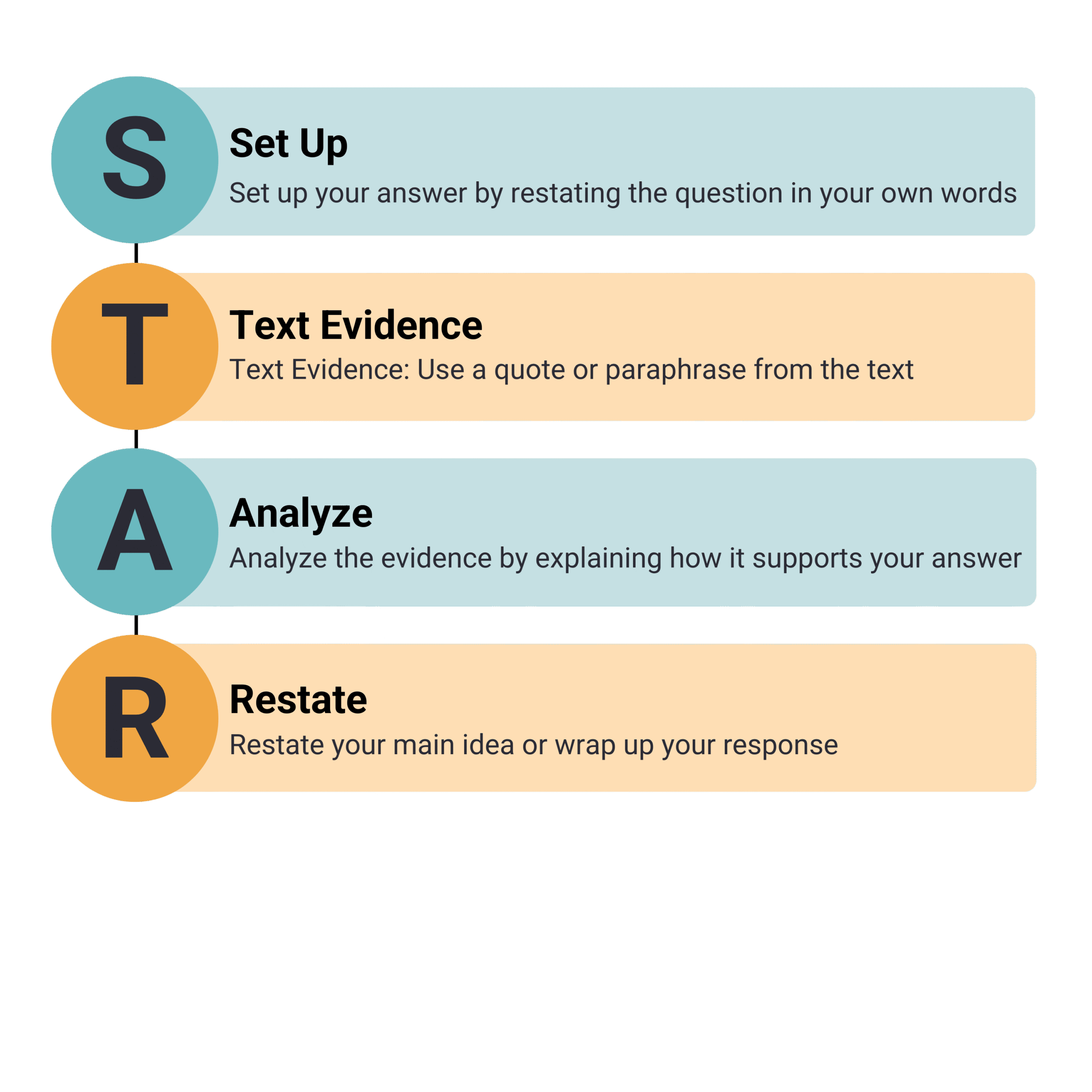
Set up, Text Evidence, Analyze, Restate (STAR) Strategy
Strategy Parameters
-
Genre: Informational / Evidence-Based Response.
-
Grade Level: Upper Elementary to Middle School (Grades 4–8).
-
Writing Process: Planning and Drafting.
At-A-Glance
STAR (Set up, Text Evidence, Analyze, Restate) is a structural strategy designed to help students write focused, text-based responses by organizing their thinking and incorporating evidence. This structure reduces ambiguity and helps students move beyond summarizing to develop thoughtful, analytical explanations of how their evidence supports their main idea. The approach builds confidence and strengthens their ability to write with clarity and purpose across various subjects.
Learn More
Troubleshooting
- Students skip the analysis step
→ Model how to explain why evidence matters
→ Prompt: “What does this show?” - Responses are too short or incomplete
→ Encourage elaboration with sentence starters
→ Prompt: “Can you explain more about your answer?” - Students struggle to find text evidence
→ Highlight or pre-select key parts of the text
→ Prompt: “Where does the text support your idea?” - Students restate instead of analyze
→ Teach the difference using examples
→ Prompt: “Are you repeating or explaining?” - Students forget steps in the process
→ Use color-coded visuals and checklists
→ Prompt: “Do you have all four STAR parts?”
Adaptations
- Provide sentence starters for each step (“I believe…”, “The text says…”, “This shows…”)
- Use color-coded graphic organizers for each STAR component
- Include visual icons (speech bubble, book, magnifying glass, etc.)
- Allow oral rehearsal before writing
- Use peer collaboration (split STAR steps between partners)
- Provide pre-selected quotes or evidence for support
- Use fill-in-the-blank templates for beginners
- Incorporate digital tools for highlighting and organizing responses
- Offer structured checklists for self-monitoring
Key Takeaways
- STAR provides a clear structure for evidence-based writing
- The strategy strengthens students’ ability to support and explain ideas
- Explicit modeling and scaffolding are essential for success
- Students benefit from separating each step of the writing process
- The strategy promotes deeper thinking and analysis
- With practice, students can independently construct strong written responses
Case Study Example
Jaden, a 7th grade student, struggles with organizing his ideas in writing and often produces short, unsupported responses. While he demonstrates strong verbal thinking during discussions, his written work lacks structure, evidence, and explanation.
To support him, his teacher introduces the STAR strategy as a structured approach to help him organize his responses and incorporate evidence more effectively.
The teacher introduces STAR over several days using scaffolded instruction.
She models:
- Set Up: Restating the question as a clear answer
- Text Evidence: Finding and including supporting details from the text
- Analyze: Explaining why the evidence matters
- Restate: Restating the main idea in a new way
Students:
- Use color-coded anchor charts and graphic organizers
- Practice identifying each STAR component in sample responses
- Participate in guided practice and peer collaboration
- Rehearse ideas verbally before writing
Jaden initially writes:
“Martin Luther King Jr. is important because he helped people.”
Using STAR:
- Set Up: Clearly answers the question
- Text Evidence: Adds a quote or example
- Analyze: Explains why the evidence matters
- Restate: Reinforces the main idea
Revised version:
“Martin Luther King Jr. is an important leader because he helped bring change to civil rights. The text says that he led peaceful marches and gave powerful speeches like ‘I Have a Dream.’ This shows that he used his voice to fight for equality and inspire others. That’s why he is remembered as a leader who made a lasting impact.”
Jaden shows significant improvement in both structure and depth, producing responses that include clear ideas, relevant evidence, and thoughtful analysis. His confidence increases as he begins to understand how to organize his thinking in writing.
Across the class, students demonstrate stronger comprehension and writing skills, using evidence more effectively and explaining their ideas with greater clarity. The STAR strategy helps transform short, vague responses into structured, meaningful explanations.
Downloads