Topic, Introduce, Quote, Analyze (TIQA) Strategy
Strategy Parameters
- Genre: Informative
- Grade level: 6-12
- Writing Stage: Drafting, Revising
At-A-Glance
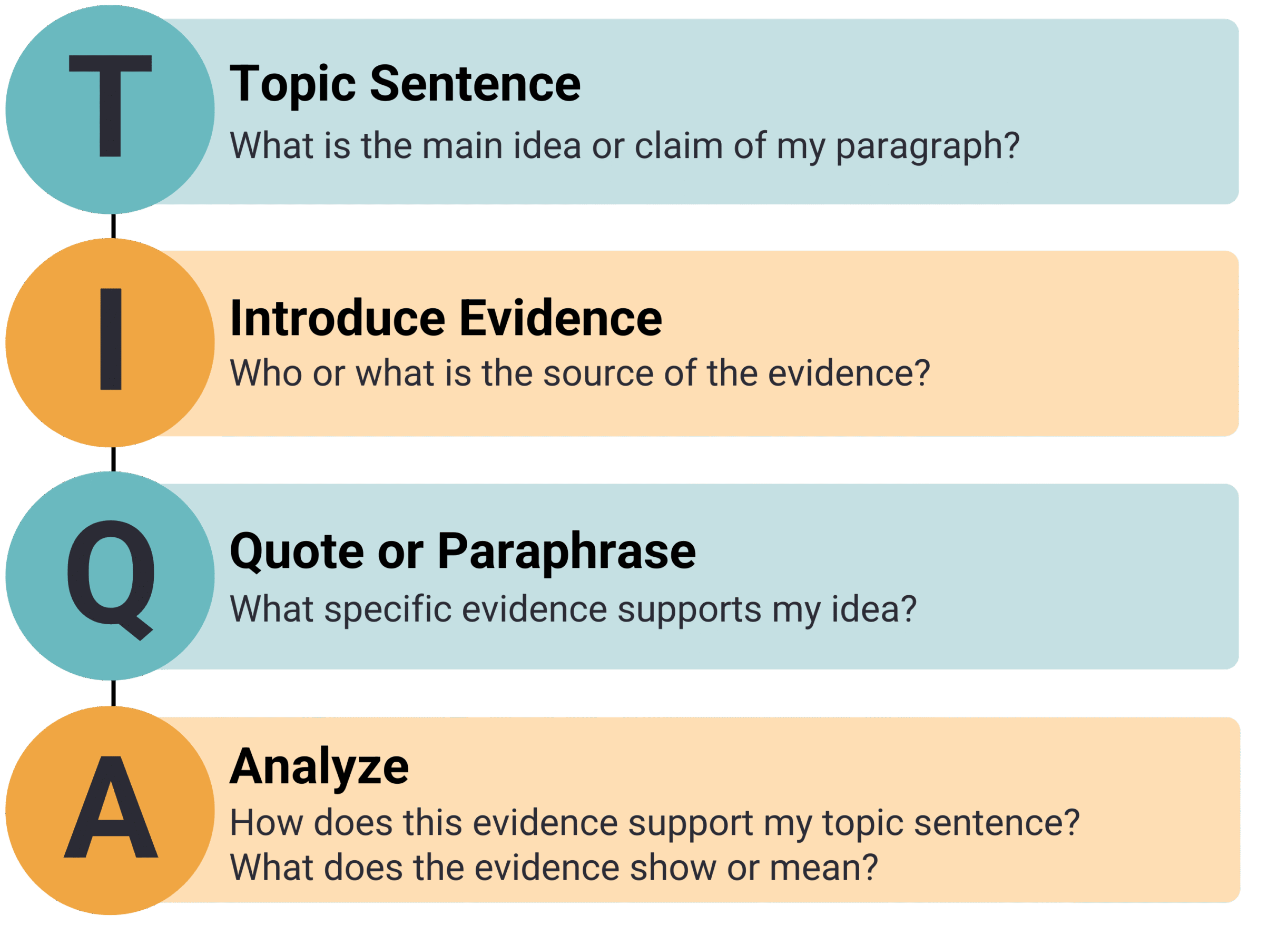
The TIQA paragraph strategy guides students in writing well-structured paragraphs containing a clear topic sentence, relevant textual evidence, and thoughtful analysis
Learn More
Troubleshooting
- Topic sentences are too vague
→ Guide students to be more specific and fully answer the question
→ Prompt: “Does your topic clearly answer the question?” - Students skip or misuse the introduction step
→ Teach how to properly introduce the speaker or source
→ Prompt: “Who said this and why should we trust them?” - Quotes don’t support the topic
→ Model how to select relevant, strong evidence
→ Prompt: “Does this quote actually prove your point?” - Students only include quotes without explanation
→ Emphasize that analysis is required
→ Prompt: “What does this quote show?” - Students summarize instead of analyze
→ Teach the difference using examples
→ Prompt: “Are you explaining the meaning or just repeating it?”
Adaptations
- Provide sentence starters for each step (“According to…”, “This shows…”)
- Use color-coded highlighting for each TIQA component
- Offer graphic organizers with labeled sections
- Allow oral rehearsal before writing
- Provide lists of synonyms for “said” to strengthen introductions
- Use high-interest or shorter texts for practice
- Offer pre-selected quotes for struggling students
- Use peer collaboration for planning and feedback
- Include checklists for self-monitoring
Key Takeaways
- TIQA provides a clear structure for evidence-based writing
- The strategy strengthens students’ ability to support and analyze ideas
- The analysis step is the most critical and should be emphasized
- Explicit modeling and guided practice are essential
- Students benefit from separating each part of the writing process
- With practice, students develop stronger, more analytical responses
Case Study Example
Ms. Ramirez, a 7th grade social studies teacher, notices that her students often provide vague answers when responding to questions about texts. While they can share ideas verbally, their written responses lack evidence and explanation.
To address this, she introduces the TIQA strategy to help students structure their responses and support their ideas with credible textual evidence.
Ms. Ramirez introduces TIQA using a think-aloud and interactive modeling.
She models:
- Topic Sentence: Clearly answering the question
- Introduce: Identifying the speaker or source
- Quote: Providing accurate textual evidence
- Analyze: Explaining how the evidence supports the claim
Students:
- Practice identifying each TIQA component in sample paragraphs
- Use graphic organizers and sentence starters
- Work in pairs and independently to write responses
- Use color-coding and checklists to review their work
A student initially writes:
“Voting is important because it helps the country.”
Using TIQA:
- Topic Sentence: Clearly answers the question
- Introduce: Identifies the source
- Quote: Adds relevant evidence
- Analyze: Explains the meaning
Revised version:
“Voting is important in a democracy because it allows citizens to have a voice in government decisions. In his Inaugural Address, President John F. Kennedy stated, ‘Ask not what your country can do for you—ask what you can do for your country.’ This quote shows that democracy depends on citizens taking responsibility and actively participating, rather than expecting the government to do everything for them.”
Students begin writing more detailed and structured responses that include both evidence and explanation. Ms. Ramirez observes that students are no longer relying on vague ideas but are using specific quotes to support their claims.
Across the class, writing becomes more analytical and purposeful, and students gain confidence in their ability to support and explain their thinking. The TIQA strategy helps transform short, unsupported answers into strong, evidence-based paragraphs.
Downloads