
Add, Remove, Move, Substitute (ARMS) Strategy
Strategy Parameters
- Genre: All genres (narrative, informative, persuasive)
- Grade Level: Grades 3-8
- Writing Process: Revising
At-A-Glance
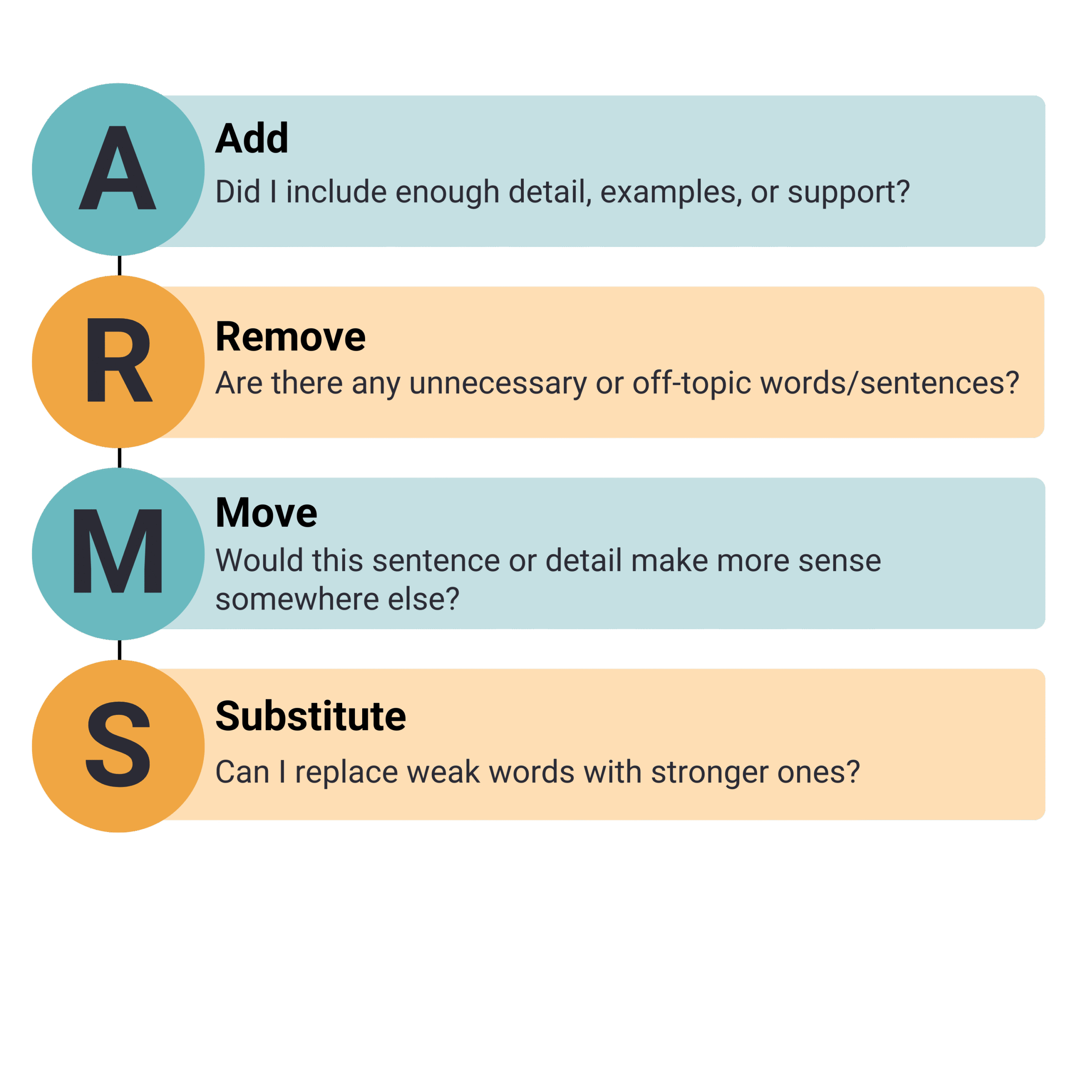
The ARMS (Add, Remove, Move, Substitute) strategy provides students with four concrete, actionable steps to approach the intimidating task of revising their writing. It structures the revision process to focus on organization, clarity, and precision, encouraging students to look beyond surface-level edits. By consistently practicing these four steps, students develop stronger habits for evaluating how each sentence contributes to their overall message, thereby revising their work with greater intention.
Learn More
Troubleshooting
Students skip steps
- What to do: Assign one step per revision round
- Prompt: “Today, focus only on moving ideas.”
Students make surface-level changes
- What to do: Use mentor texts to show depth
- Prompt: “What new detail would help the reader visualize better?”
Students confuse revising with editing
- What to do: Clarify that ARMS is about ideas, not spelling
- Prompt: “Does this change help the reader understand better?”
Students overwhelmed by too many changes
- What to do: Focus on one ARMS letter per session
- Prompt: “Let’s just work on ‘Add’ today.”
Struggle to identify what to revise
- What to do: Use peer models and guided questions
- Prompt: “What part feels confusing or boring?”
Adaptations
- Include ARMS sentence frames (“I added a detail about ___”)
- Use icons (➕➖🔁🔤) to represent steps visually
- Use digital tools like Google Docs with comment features for revision.
- Provide audio-recorded instructions for each ARMS step.
- Allow students to revise using speech-to-text tools.
- Offer sentence starters for each revision type.
Key Takeaways
- Scaffold each ARMS step with visuals, modeling, and hands-on tools.
- Use metaphors (like gardening) to make abstract concepts concrete.
- Support struggling learners with conferencing, sentence stems, and color coding.
- Celebrate revision as growth—not correction.
Case Study Example
Ms. Rivera teaches a diverse group of 6th-grade students, many of whom struggle with writing fluency, organization, and confidence. Several students have IEPs for learning disabilities in written expression. She notices that when asked to revise, most students either make surface-level edits (like fixing spelling) or say, “I’m done.”
She decides to implement the ARMS strategy—Add, Remove, Move, Substitute—using a garden analogy to make revision more concrete and engaging.
Ms. Rivera introduces ARMS over the course of a week, focusing on one letter per day. She uses anchor charts with garden visuals (e.g., “Add = Plant new seeds”) and models each step with a shared paragraph on the board.
On Day 3, she focuses on “Move.” She shows a paragraph written out of order and uses sentence strips to physically rearrange ideas with the class. Students then try the same with their own writing using scissors and glue sticks.
Jamal, a student with ADHD and writing anxiety, writes:
“I saw a butterfly. Then I went to the garden. It was fun. The flowers were red and yellow.”
Ms. Rivera sits with Jamal during writing time and uses the ARMS checklist. Together, they:
- Add: Jamal adds a sentence about the butterfly landing on a flower.
- Remove: He deletes “It was fun” and replaces it with a more specific feeling.
- Move: He rearranges the sentences so the garden visit comes first, then the butterfly.
- Substitute: He changes “red and yellow” to “bright red tulips and golden sunflowers.”
Revised version:
“I went to the garden and saw bright red tulips and golden sunflowers. A butterfly landed on one of the petals. I felt amazed watching it flutter away.”
Jamal beams when he reads his revised paragraph aloud. Ms. Rivera notices that using ARMS gave him a clear structure and purpose for revision. Other students begin using the garden terms (“I’m pulling weeds!”) to talk about their writing. Over time, revision becomes less intimidating and more creative.
Downloads