Hamburger Strategy
Strategy Parameters
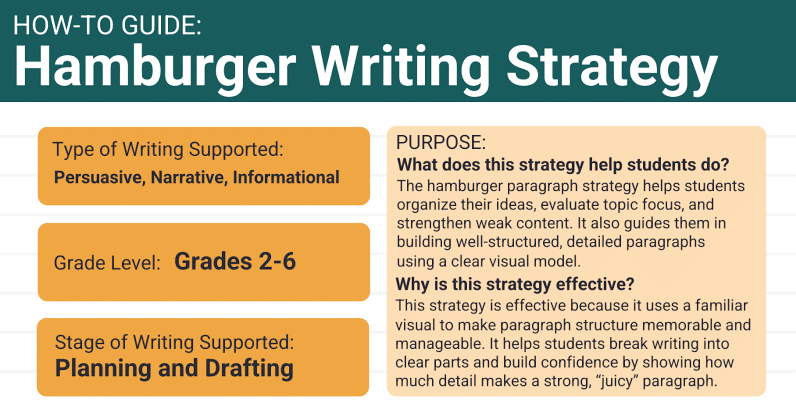
- Genre: All.
- Grade Level: Grades 2–6.
- Writing Process: Planning and drafting.
At-A-Glance
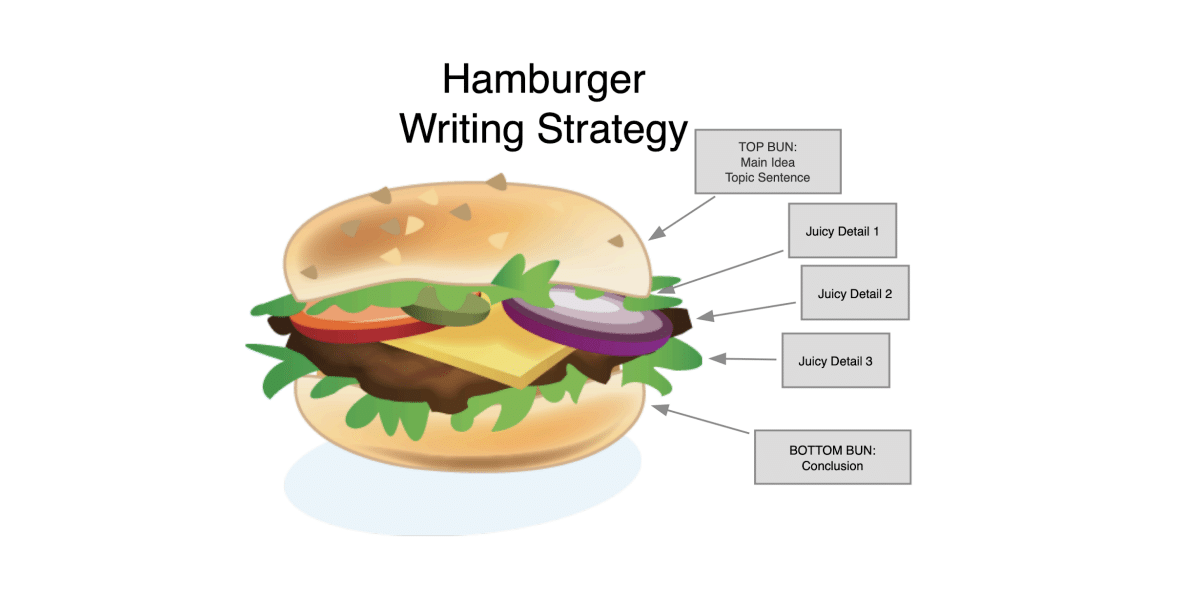
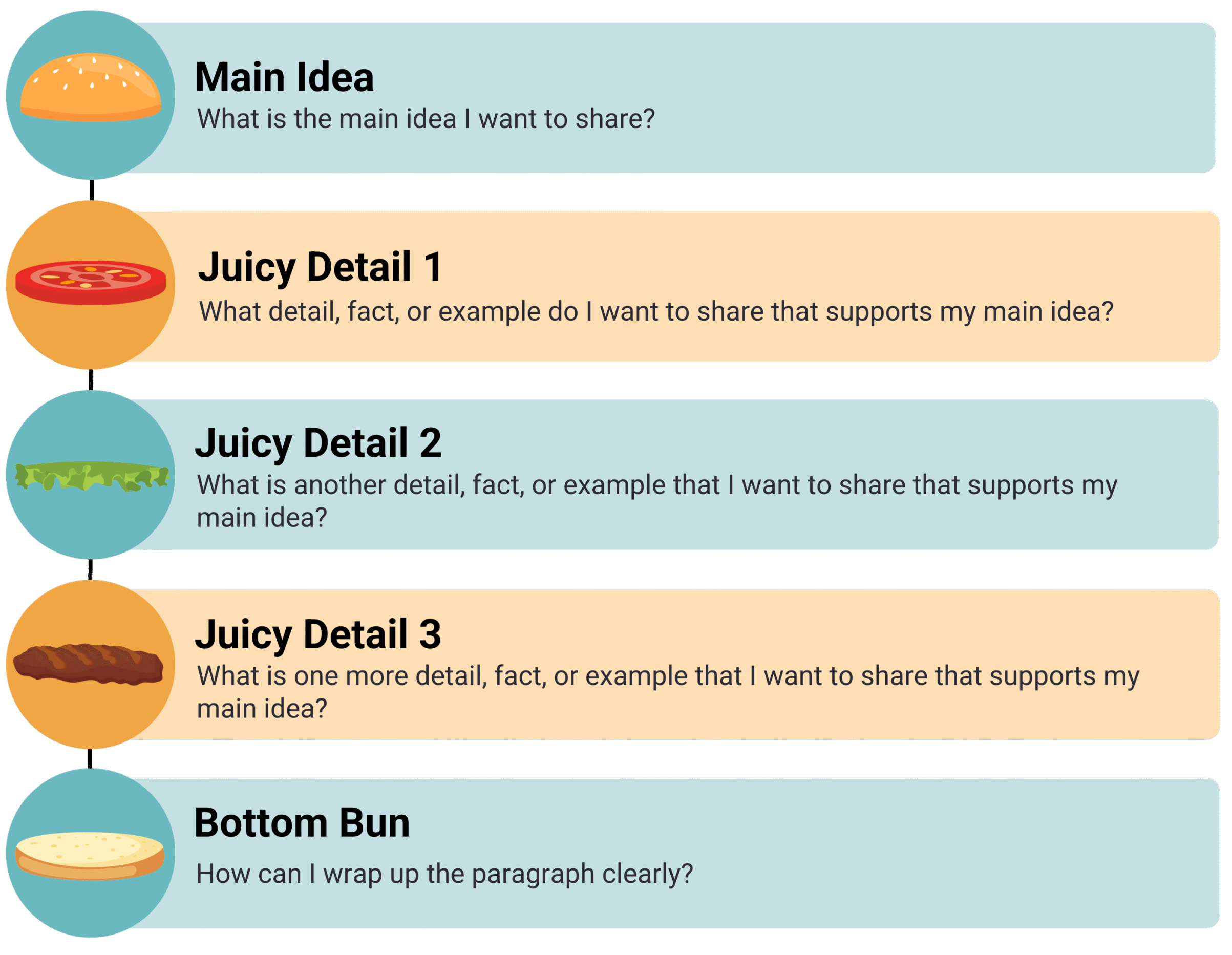
The Hamburger Paragraph Strategy uses the familiar visual of a hamburger to teach students the structural components of a strong paragraph, mapping the topic sentence, supporting details, and conclusion to the buns and fillings. This concrete metaphor helps students plan their content depth, check their organization, and ensure their paragraph has enough “juicy” supporting details. The approach simplifies paragraph writing into manageable, memorable parts, which strengthens independence for young writers.
Learn More
Troubleshooting
- Topic sentence is too vague
→ Model stronger examples and ask for specificity
→ Prompt: “What is your paragraph really about?” - Details are repetitive or weak
→ Encourage variety and expansion using sentence stems
→ Prompt: “Can you add a new idea that’s different?” - Missing conclusion (bottom bun)
→ Model how to wrap up ideas clearly
→ Prompt: “What is your final message to the reader?” - Students don’t understand the metaphor
→ Reinforce with visuals and hands-on models
→ Prompt: “Where does this sentence fit in the burger?” - Details lack development
→ Provide word banks and examples
→ Prompt: “Can you add more description or explanation?”
Adaptations
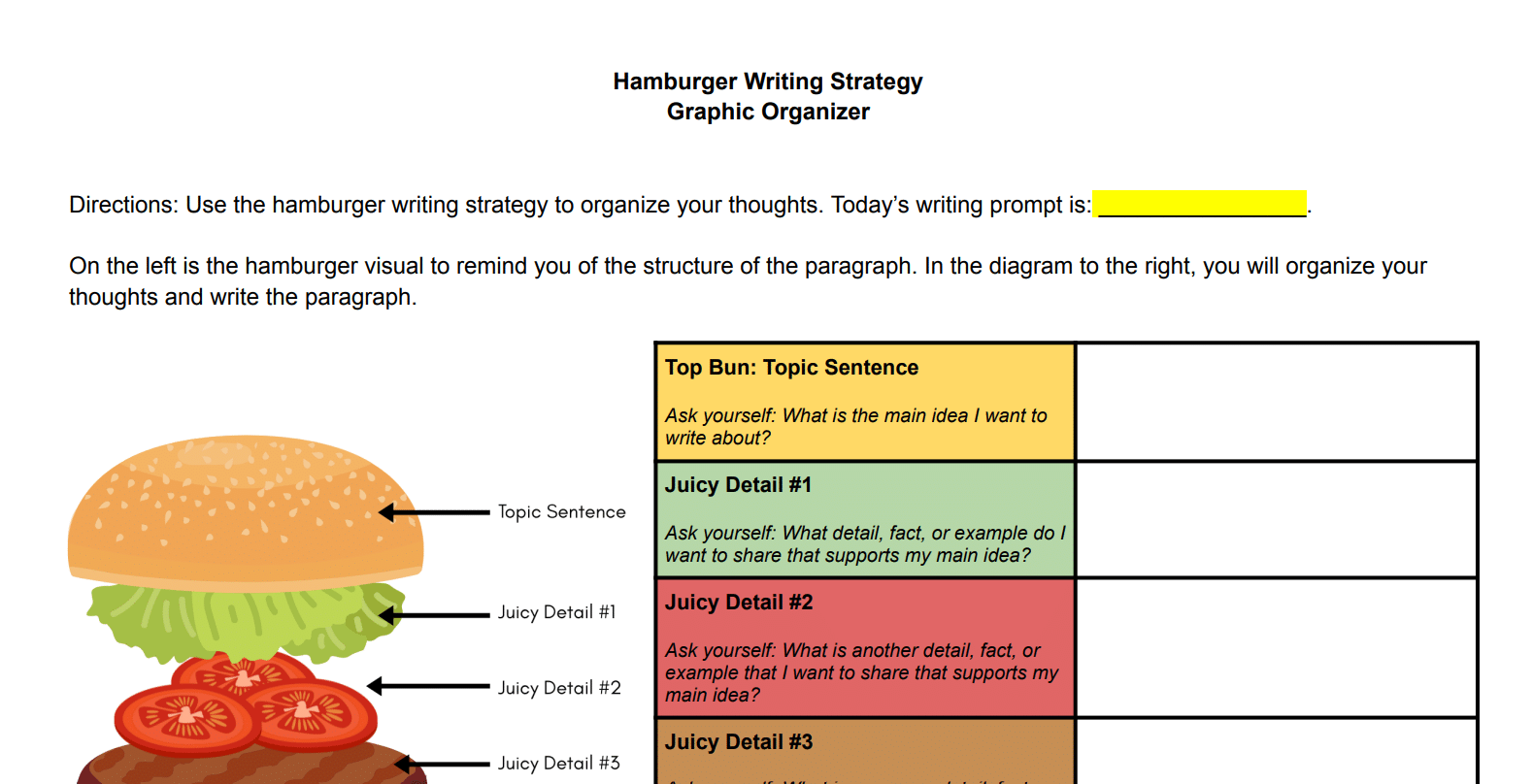
- Use a visual hamburger graphic organizer (paper or digital)
- Provide sentence starters:
- “One important reason is…”
- “For example…”
- “In conclusion…”
- Offer transition word lists to strengthen flow
- Use cut-and-paste burger pieces for hands-on learners
- Chunk writing into steps (topic → details → conclusion)
- Provide descriptive word banks to “spice up” writing
- Incorporate group activities (paragraph assembly, sorting games)
- Use color-coding for each part of the paragraph
Key Takeaways
- The hamburger metaphor makes abstract writing structure concrete and memorable
- Visual and hands-on supports improve student understanding and engagement
- Breaking writing into parts reduces overwhelm and builds confidence
- Strong paragraphs require multiple, distinct supporting details
- With practice, students can independently organize and evaluate their writing
Case Study Example
She uses a visual hamburger model and hands-on materials to help students understand paragraph structure in a concrete, engaging way.
She explains:
Top Bun: “This tells your reader what your paragraph is about.”
Fillings: “These are your supporting details—make them strong and different.”
Bottom Bun: “This wraps everything up.”
Students:
Analyze a sample paragraph and identify each part
Highlight topic sentences, details, and conclusions in different colors
Use a hamburger graphic organizer to plan their own paragraph
Write independently while referencing the visual model
Ethan, a student who struggles with writing development, initially writes:
“Dogs are good pets. They are nice. They are fun.”
With teacher guidance using the Hamburger strategy:
Top Bun: “Dogs are great pets for many families.”
Detail 1: Explains dogs are loyal
Detail 2: Adds that dogs are playful
Detail 3: Includes that dogs can protect their owners
Bottom Bun: Restates why dogs are great pets
Revised version:
“Dogs are great pets for many families. First, they are very loyal and love their owners. In addition, dogs are playful and enjoy spending time with people. They can also protect their homes and keep families safe. For these reasons, dogs make wonderful pets.”
Writing becomes more organized and complete
Students include multiple, distinct supporting details
Learners begin using more descriptive and varied language
Students reference the hamburger visual independently when writing
Downloads