Pick My Ideas, Organize My Notes, Write and Say More (POW) Strategy
Strategy Parameters
- Genre: Informational
- Grade Level: All grade levels
- Writing Process: Planning
At-A-Glance
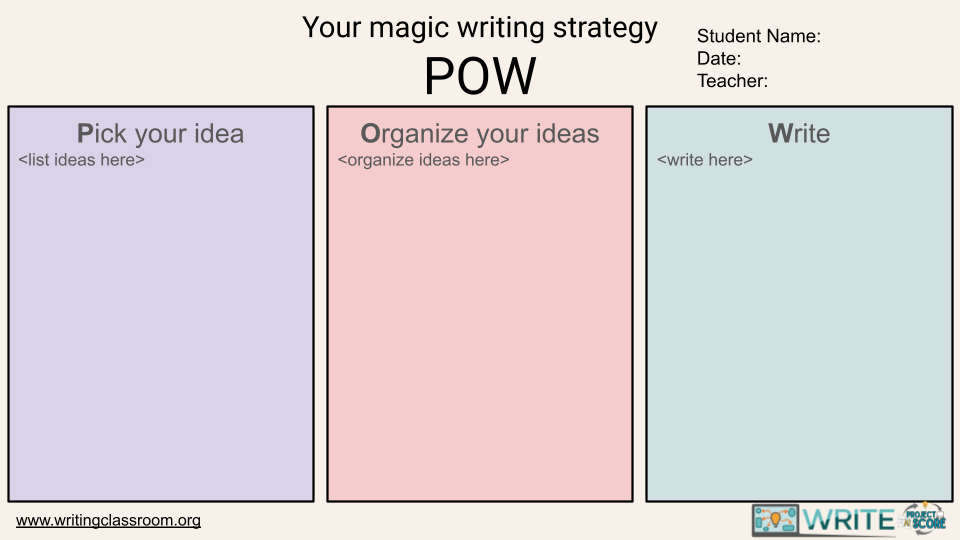
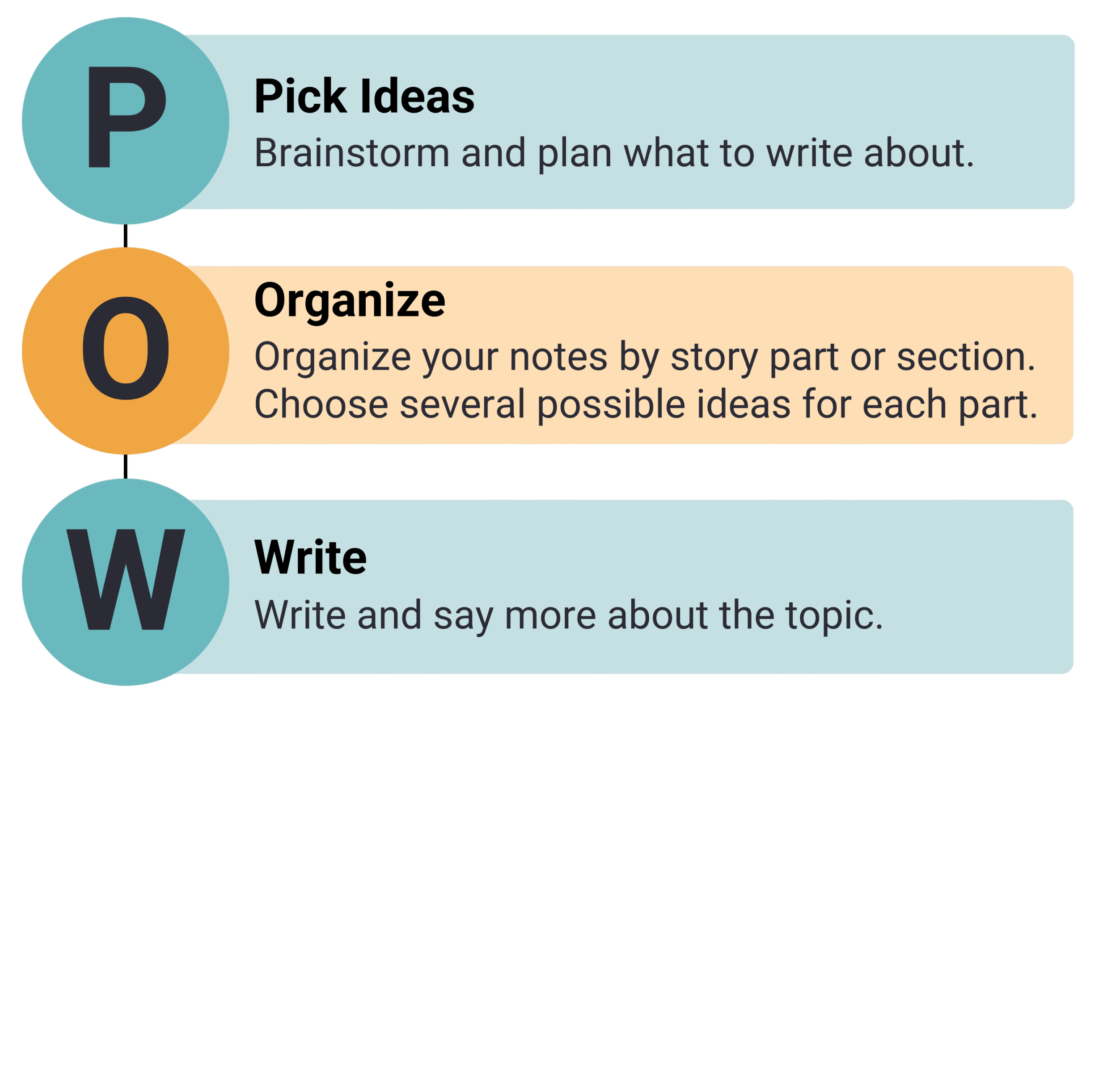
POW is a foundational Self Regulated Strategy Development (SRSD) strategy designed to help students plan and organize their thoughts before drafting a piece of writing. It is a simple, flexible tool that reduces cognitive load, making it suitable for a wide range of learners and appropriate for use across various content areas and genres. The strategy supports idea generation and organization, serving as a reliable starting point for more complex writing tasks.
Learn More
Troubleshooting
- Students rush into writing without planning
→ Reinforce the importance of organizing ideas first
→ Prompt: “What are your notes before you start writing?” - Students struggle to generate ideas
→ Provide guided brainstorming or topic options
→ Prompt: “What do you already know about this topic?” - Students have disorganized writing
→ Use structured graphic organizers
→ Prompt: “What should come first, next, and last?” - Writing lacks detail (“say more” issue)
→ Model how to add examples and explanations
→ Prompt: “Can you give an example or explain more?” - Students forget the steps
→ Use anchor charts or visual reminders
→ Prompt: “Did you Pick, Organize, and Write more?”
Adaptations
- Provide graphic organizers with clear sections for each step
- Use pictures or drawing spaces for brainstorming ideas
- Offer sentence starters for elaboration (“For example…”, “This shows…”)
- Include word banks to support vocabulary
- Use color-coding for organizing ideas
- Chunk the strategy (focus on one step at a time)
- Provide a visual POW checklist students can keep at their desk
- Allow collaborative brainstorming before independent writing
- Use speech-to-text for idea generation
Key Takeaways
- POW simplifies the writing process into three manageable steps
- The strategy supports idea generation, organization, and elaboration
- Its simplicity makes it easy for students to remember and apply independently
- Modeling and repetition are essential for student success
- POW serves as a strong foundation for more advanced writing strategies
- Students gain confidence by focusing on process rather than perfection
Case Study Example
Ms. Rivera introduces the POW strategy to her 7th grade language arts class, where many students struggle with starting their writing and organizing their ideas. She notices that students often feel overwhelmed and either write very little or jump into writing without a clear plan.
To support them, she implements POW as a simple starting strategy to help students build confidence and develop a structured approach to writing.
Ms. Rivera begins by introducing the POW acronym and modeling each step using a think-aloud.
She demonstrates:
- Pick: Choosing a clear topic
- Organize: Brainstorming and grouping ideas using a graphic organizer
- Write and say more: Expanding ideas into sentences with details
Students then:
- Choose topics relevant to their interests
- Use graphic organizers to plan their ideas
- Write paragraphs independently
- Receive feedback through teacher conferencing and class discussion
Jamal, a student who struggles with organization, initially writes:
“My favorite sport is basketball. I like it. It is fun.”
Using POW:
- Pick: Chooses basketball as his topic
- Organize: Lists ideas (dribbling, teamwork, shooting)
- Write and say more: Expands each idea with details
Revised version:
“My favorite sport is basketball because it is exciting and fun to play. I enjoy dribbling the ball quickly and trying to score points. I also like playing with my teammates and working together during games. Basketball is fun because every game is different and full of energy.”
Jamal shows improvement in both organization and detail, producing a more complete and engaging paragraph. Ms. Rivera notices that students are more willing to start writing and are less overwhelmed by the process.
Across the class, students begin to use the POW steps independently and add more detail to their writing. The strategy helps build confidence and provides a strong foundation for more advanced writing skills.
Downloads