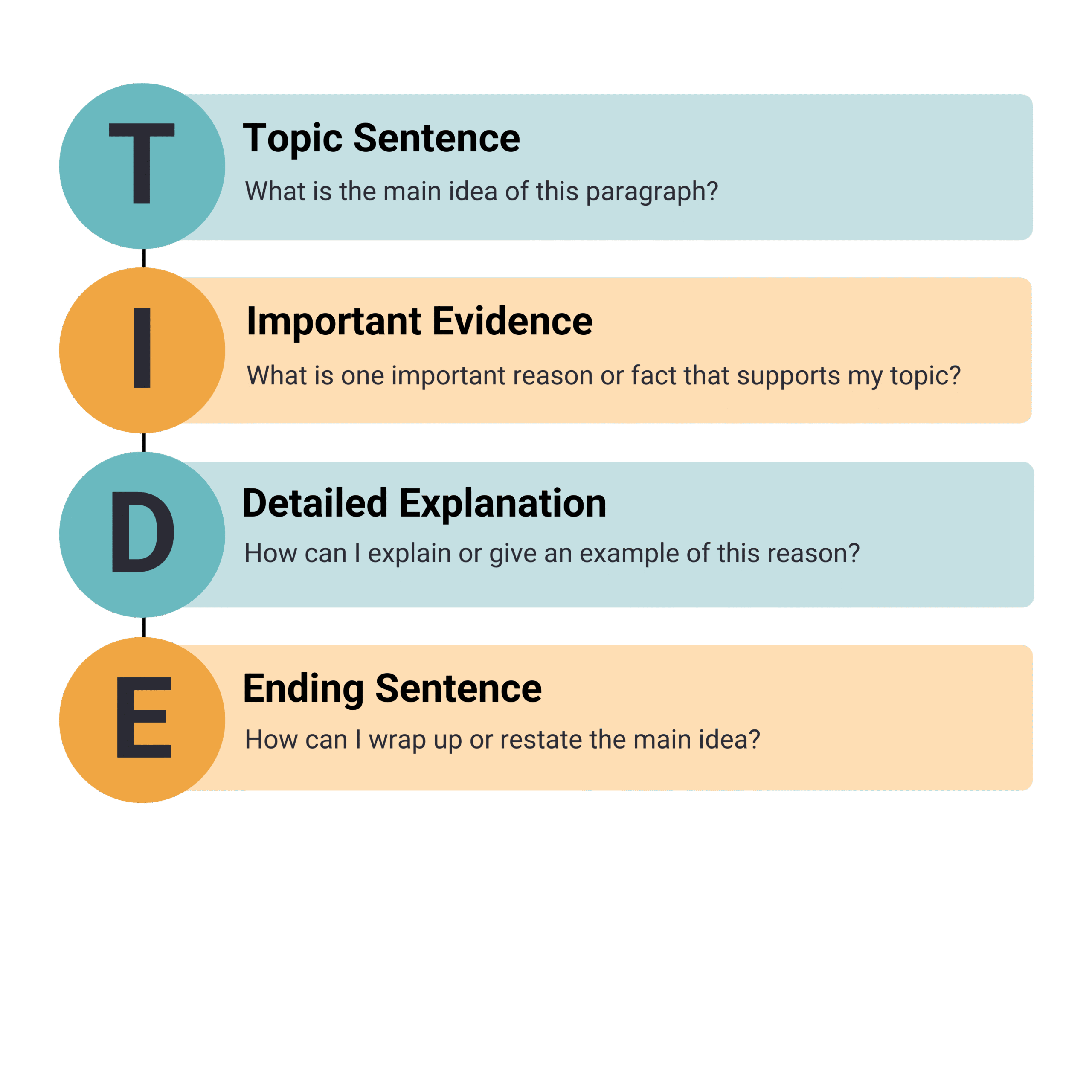
Topic, Important Evidence, Detailed Explanation, Ending (TIDE) Strategy
Strategy Parameters
- Genre: All.
- Grade Level: Grades 3-8
- Writing Process: Planning and drafting.
At-A-Glance
The TIDE strategy provides a structured, scaffolded approach (Topic, Important Evidence, Detailed Explanation, Ending) for students, particularly struggling or beginning writers, to compose clear informational paragraphs. Its utility extends beyond English language arts into other subject areas like science and social studies, offering a reliable organizational framework. Successful integration requires explicit teacher modeling, the use of visual aids, and systematic practice to ensure students understand the purpose behind each structural component.
Learn More
Troubleshooting
- Topic sentences are vague or missing
→ Model clear, focused examples and use sentence starters
→ Prompt: “What is the main point you want to prove?” - Evidence is weak or off-topic
→ Teach how to choose relevant, strong support
→ Prompt: “Does this actually support your idea?” - Students repeat instead of adding evidence
→ Show how evidence adds new information
→ Prompt: “What is a fact or example that proves this?” - Students skip the explanation (D step)
→ Emphasize explaining why evidence matters
→ Prompt: “Why is this important?” - Explanations are too short or unclear
→ Use guided questions and peer discussion
→ Prompt: “How does this show your point?” - Ending sentences are weak or missing
→ Model how to restate ideas clearly
→ Prompt: “What do you want the reader to remember?”
Adaptations
- Provide sentence starters for each step (“One reason…”, “For example…”, “This shows…”)
- Use color-coded graphic organizers for each TIDE component
- Allow oral rehearsal before writing
- Use sticky notes for each step and organize them into a paragraph
- Provide pre-selected evidence for struggling students
- Pair writing with drawing to generate ideas
- Use digital organizers for flexibility
- Offer checklists to ensure all parts are included
- Use peer collaboration for feedback and revision
Key Takeaways
- TIDE simplifies paragraph writing into four clear, structured parts
- The strategy emphasizes both evidence and explanation
- Students learn to build complete, well-developed paragraphs
- Explicit modeling is critical, especially for the explanation step
- The strategy supports struggling writers while building independence
- Writing improves when students understand the purpose of each sentence
Case Study Example
Mr. Harris, a 7th grade English teacher, notices that while his students can write topic sentences, their paragraphs often lack strong evidence and explanation. Many assume their ideas are “obvious” and fail to explain their thinking, resulting in underdeveloped writing.
To address this, he introduces the TIDE strategy to help students structure their paragraphs and better connect their ideas to supporting details.
Mr. Harris introduces TIDE over several days using modeling, guided practice, and independent work.
He models:
- Topic Sentence: Clearly stating the main idea
- Important Evidence: Adding a supporting fact or example
- Detailed Explanation: Explaining why the evidence matters
- Ending Sentence: Restating the main idea
Students:
- Use graphic organizers and sentence starters
- Practice writing paragraphs collaboratively and independently
- Highlight each TIDE component using color coding
- Participate in peer review using a checklist
A student initially writes:
“Dogs are good pets. They are fun. That’s why people like them.”
Using TIDE:
- Topic Sentence: States a clear main idea
- Important Evidence: Adds a specific reason
- Detailed Explanation: Explains why it matters
- Ending Sentence: Restates the idea
Revised version:
“Dogs are great pets because they are loyal and fun to be around. For example, dogs enjoy playing with their owners and can keep them company. This shows that dogs help people feel happy and less lonely. That’s why many people choose dogs as their pets.”
Students begin writing more complete and structured paragraphs, including both evidence and explanation. Mr. Harris notices that students are no longer stopping after stating a fact but are taking the extra step to explain their thinking.
Across the class, writing becomes more clear and developed, and students gain confidence in their ability to express and support their ideas. The TIDE strategy helps transform short, incomplete responses into well-organized paragraphs with meaningful detail.
Downloads