Claim, Evidence, Reasoning (CER) Strategy
Strategy Parameters
-
Genre: Persuasive/Argumentative.
-
Grade Level: Middle Grades.
-
Writing Process: Planning, Drafting.
At-A-Glance
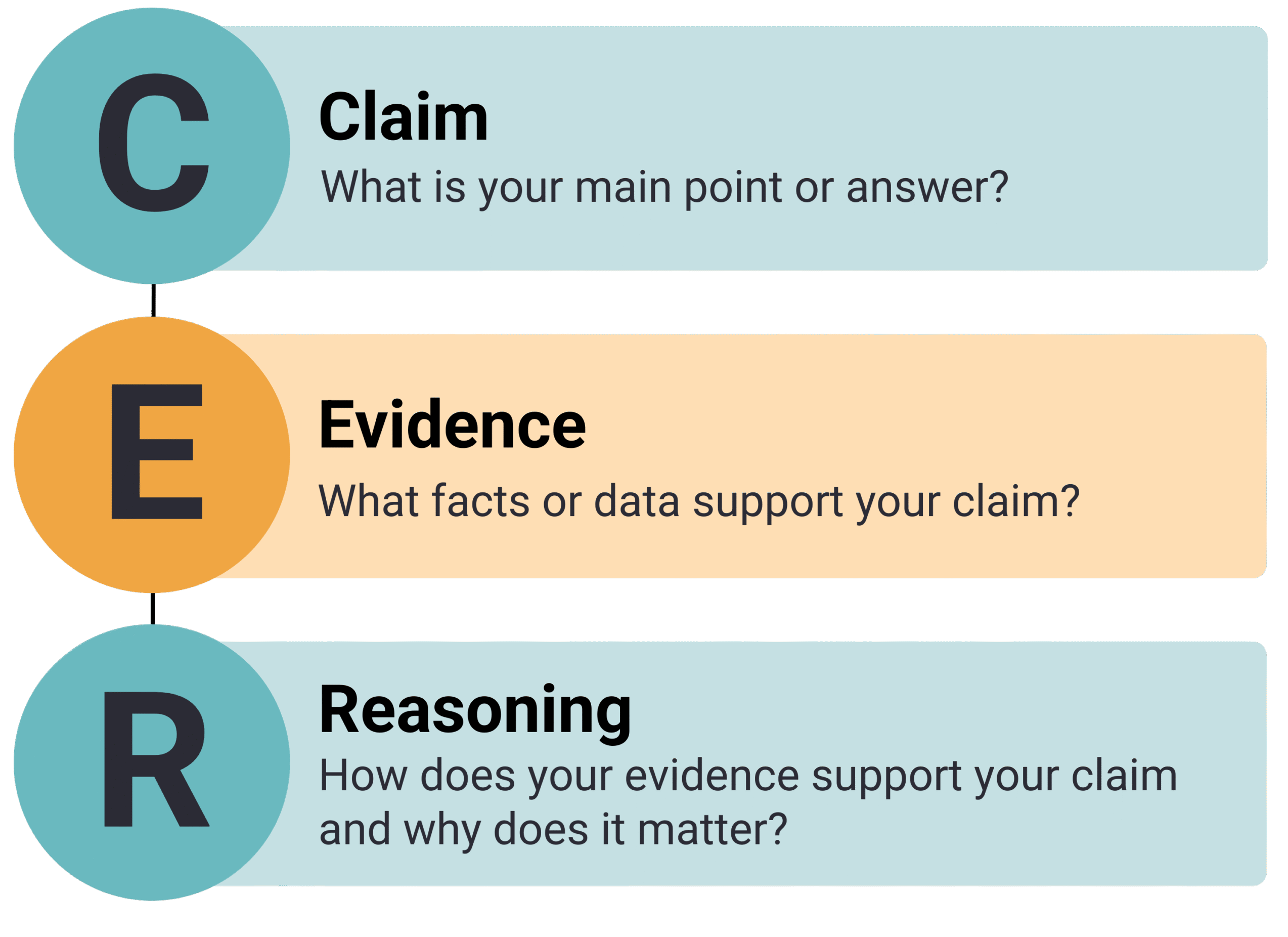
CER is a powerful writing and thinking strategy that guides students to construct clear, logical explanations by systematically presenting a claim, supporting it with evidence, and explaining their reasoning. It is effective across subjects like science and social studies, strengthening critical thinking by requiring students to justify their ideas with facts. By breaking down argumentation into manageable steps, CER helps students connect their ideas and develop strong justification skills.
Learn More
Troubleshooting
Students struggle to write a clear claim
What to do: Provide examples, sentence starters, and allow oral rehearsal
Prompt: “What do you believe about this topic?”
Students use weak or irrelevant evidence
What to do: Model strong evidence and practice with real examples (texts, data, videos)
Prompt: “Does this evidence prove your point?”
Students misunderstand reasoning
What to do: Model how evidence connects to claims using sentence frames
Prompt: “How does this prove your claim?”
Students copy evidence word-for-word
What to do: Teach paraphrasing through discussion and explanation
Prompt: “Can you explain this in your own words?”
Students’ reasoning doesn’t connect to evidence
What to do: Use graphic organizers to map claim → evidence → reasoning
Prompt: “What’s the connection between your fact and your opinion?”
Students struggle to generate ideas
What to do: Use engaging prompts, brainstorming, or drawing
Prompt: “What’s your opinion—even something simple or fun?”
Students provide minimal detail
What to do: Encourage elaboration through discussion and follow-up questions
Prompt: “Can you tell me more about why that matters?”
Students get stuck on spelling
What to do: Provide word banks or allow voice-to-text
Prompt: “Focus on your ideas—we’ll fix spelling later.”
Adaptations
- Use sentence starters and frames to support claims, evidence, and reasoning.
- Provide graphic organizers to clearly map claim → evidence → reasoning.
- Allow oral rehearsal, peer discussion, or drawing before writing.
- Incorporate word banks and vocabulary supports for writing development.
- Use technology tools like speech-to-text or text-to-speech for accessibility.
- Offer extra time and flexible pacing for students who need it.
- Provide guided practice with real examples (texts, data, videos).
Key Takeaways
- Break writing into clear steps (claim, evidence, reasoning) to reduce confusion.
- Model thinking so students understand how ideas connect.
- Use scaffolds like sentence stems, organizers, and discussion to support learners.
- Focus on clarity and explanation, not just completing the task.
Case Study Example
A 7th-grade teacher works with a small, diverse class of students learning how to write using the CER strategy (Claim, Evidence, Reasoning). Students are beginning an argumentative writing unit, and many struggle to distinguish between evidence and reasoning or to fully explain their ideas.
The teacher introduces CER by connecting it to students’ natural ability to argue and explain opinions. She defines each part (claim, evidence, reasoning) and models the process using a shared topic. Through think-alouds, she demonstrates how to write a claim, select relevant evidence, and explain reasoning.
On the second day, students work in pairs to choose topics, complete graphic organizers, and draft CER paragraphs. The teacher provides sentence frames, word banks, and ongoing feedback while circulating and modeling writing alongside students.
One pair writes:
Claim: “Recycling is important because it helps protect the environment.”
Evidence: “Recycling reduces waste in landfills and conserves resources.”
Reasoning: “Reducing waste keeps the earth clean, and conserving resources prevents shortages.”
Another student writes:
“Pets should be allowed at school. Pets can help reduce stress and make students feel happy. When students are less stressed, they can concentrate better on their work.”
Students show increased understanding of CER structure and are able to create clearer, more organized arguments. Engagement is high during both modeling and partner work, and students benefit from peer discussion and feedback.
While some students still struggle with distinguishing evidence from reasoning or using strong, fact-based evidence, the teacher’s use of scaffolds, modeling, and adjustments supports continued growth. Overall, students demonstrate improved confidence, clarity, and structure in their writing.
Downloads