Fact, Understand, Evidence, and Link (FUEL) Strategy
Strategy Parameters
- Genre: Informational, argumentative, and text-based responses
- Grade Level: Grades 4-9
- Writing Process: Planning, Drafting and Revising
At-A-Glance
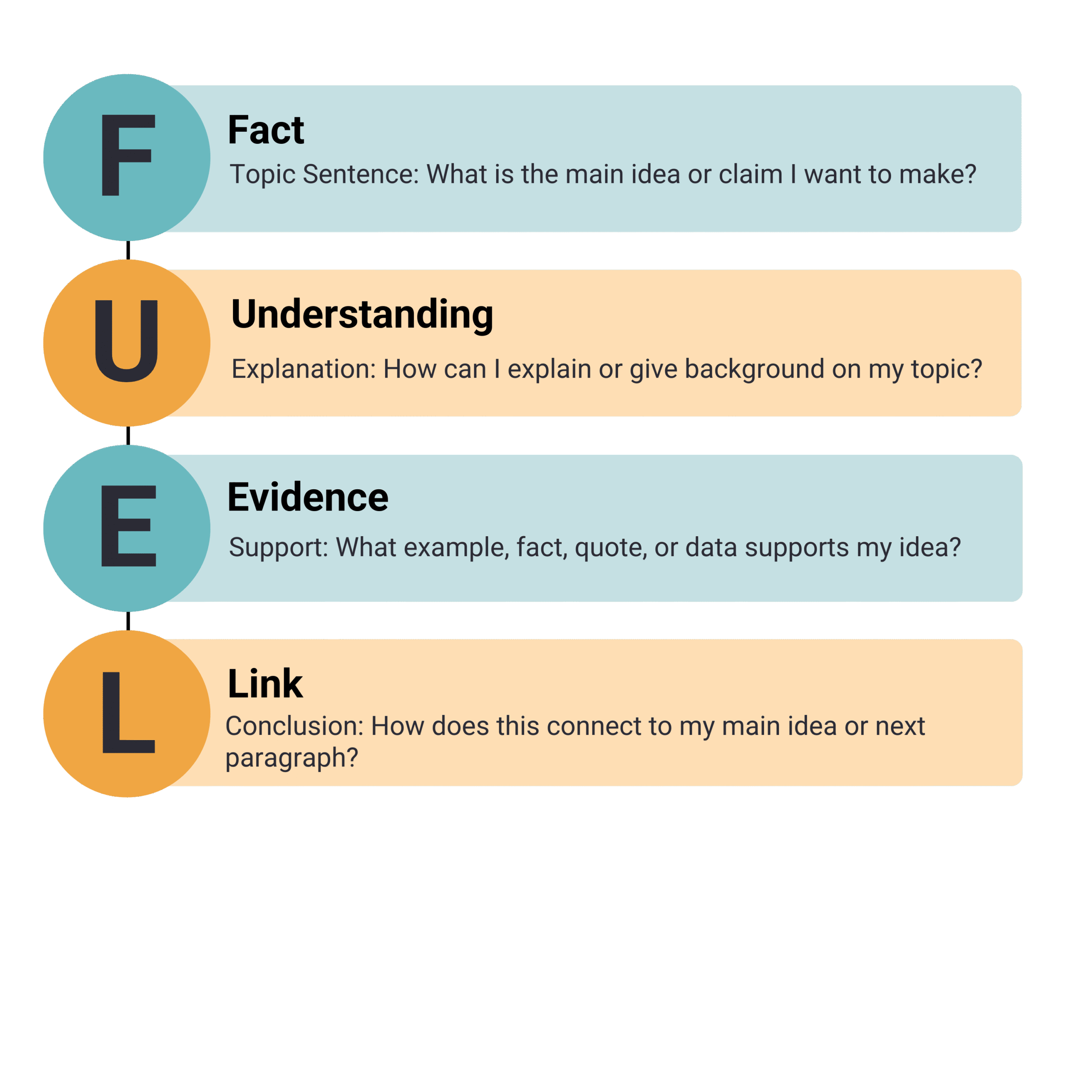
The FUEL strategy (Fact, Understand, Evidence, Link) guides students in constructing clear, organized paragraphs by emphasizing four essential components for text-based responses. It reduces writing anxiety by making expectations clear, helping students write strong topic sentences, explain their thinking, and support ideas with relevant evidence. By breaking the process into manageable steps, FUEL encourages deeper thinking and supports consistent writing quality across subjects.
Learn More
Troubleshooting
- Students don’t understand “Focus” (topic sentence)
→ Clarify it is the main idea or claim
→ Prompt: “What are you trying to explain or prove?” - Students skip the “Understand” step
→ Model how to explain ideas before adding evidence
→ Prompt: “Why does this matter?” - Evidence is weak or missing
→ Teach how to use examples, quotes, or facts
→ Prompt: “What is your proof?” - Students repeat evidence instead of linking
→ Show how to explain significance, not restate
→ Prompt: “What does this show?” - Writing feels robotic
→ Encourage flexible sentence structure and voice
→ Prompt: “Can you combine ideas or make it sound more natural?” - Students forget steps
→ Use a checklist or graphic organizer
→ Prompt: “Do you have F, U, E, and L?”
Adaptations
- Provide sentence starters for each step (“One reason is…”, “This shows…”)
- Use graphic organizers with visuals/icons for each part
- Break writing into one step per day (chunking)
- Allow collaborative brainstorming before independent writing
- Provide vocabulary word banks for ELL students
- Use color-coded examples and mentor texts
- Offer digital templates (Google Docs/Slides with FUEL sections)
- Use checklists for self-assessment and revision
Key Takeaways
- FUEL simplifies paragraph writing into manageable, structured steps
- Explicit modeling and scaffolding are essential for student success
- The strategy reduces cognitive overload and writing anxiety
- Students benefit from clear expectations and predictable structure
- FUEL promotes deeper thinking by connecting ideas to evidence
- With practice, students can independently organize and evaluate their writing
Case Study Example
Her goal is to help students move beyond short, underdeveloped responses and begin writing structured, evidence-based paragraphs. She introduces FUEL using an anchor chart, guiding questions, and color-coded examples to make each step explicit and accessible.
Ms. Rivera models the FUEL strategy using a think-aloud before students begin writing.
She walks through each step:
Focus: Clearly answer the prompt
Understand: Explain why the idea matters
Evidence: Pull a fact or example from a text or experience
Link: Explain how the evidence supports the claim
Students then:
Use a graphic organizer to plan their paragraph
Work in pairs to brainstorm ideas
Write independently using sentence starters and visual supports
Maria, an English Leanguage Learner, initially writes:
“Phones are good. They help students. I like phones.”
With teacher support using FUEL:
Focus: “Students should be allowed to have phones in school.”
Understand: She explains that phones can help with communication and learning
Evidence: Adds an example of using phones to look up information
Link: Connects back to how phones support student success
“Students should be allowed to have phones in school because they can be helpful learning tools. Phones allow students to look up information and stay connected in emergencies. For example, students can use their phones to check definitions or contact their parents if needed. This shows that phones can support both safety and learning when used responsibly.”
Students begin writing longer, more structured paragraphs
ELL students use clearer explanations with sentence supports
Writing becomes more organized and purposeful
Students report feeling more confident because they “know what to do next”
Paragraphs show stronger connections between ideas and evidence
Downloads