Plan, Organize, Write, Edit, Revise (POWER) Strategy
Strategy Parameters
-
Genre: Persuasive, narrative, informational.
-
Grade Level: 6–12.
-
Writing Process: Planning, organization, drafting, editing, revising.
At-A-Glance
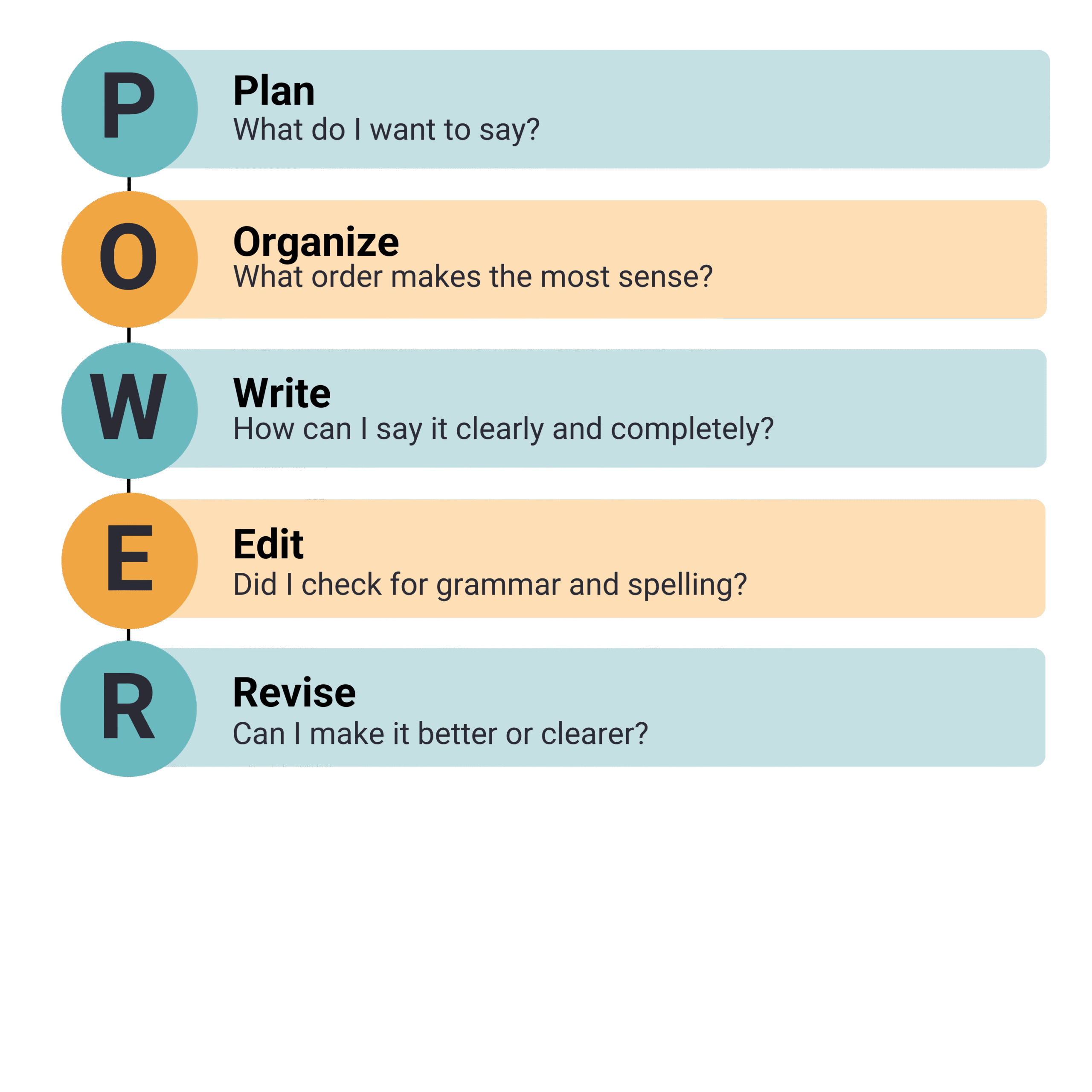
The POWER strategy breaks the entire writing process into five structured, manageable steps: Plan, Organize, Write, Edit, and Revise. The strategy supports executive functioning skills and is especially useful for building independence and confidence in students, including those with learning differences.
Learn More
Troubleshooting
- Students skip the planning stage
→ Reinforce brainstorming with visuals and guided discussion
→ Prompt: “What do you want to say before you start writing?” - Students struggle with organization
→ Use graphic organizers and sequencing tools
→ Prompt: “What should come first, next, and last?” - Confusion between editing and revising
→ Teach the difference using examples and color-coding
→ Prompt: “Are you fixing mistakes or improving ideas?” - Students feel overwhelmed by all steps
→ Chunk the process across multiple days
→ Prompt: “Today we’re only focusing on planning.” - Students avoid writing due to fear of mistakes
→ Encourage drafting without pressure
→ Prompt: “Write first, fix later.” - Writing lacks detail or depth
→ Provide word banks and revision strategies
→ Prompt: “How can you make this more clear or interesting?”
Adaptations
- Use color-coded graphic organizers for each step
- Provide sentence starters for planning and drafting
- Allow speech-to-text for drafting ideas
- Break the process into smaller chunks (one step per day)
- Use visual anchor charts for each stage (Plan, Organize, etc.)
- Provide checklists for editing and revising
- Incorporate peer collaboration for feedback
- Use examples and mentor texts for modeling
- Offer flexible tools (drawing, verbal planning, digital writing)
Key Takeaways
- POWER supports the full writing process from planning to revision
- Breaking writing into steps reduces overwhelm and increases clarity
- Students develop independence through structured practice
- Explicit modeling and scaffolding are essential
- Writing improves when students separate drafting, editing, and revising
- The strategy encourages reflection and continuous improvement
Case Study Example
Ms. Rivera introduces the POWER strategy to her 8th grade class during a writing unit where students are expected to produce longer, more developed pieces. She notices that many students either rush through assignments or struggle to revise their work effectively.
To support them, she implements POWER as a structured process to guide students through each stage of writing, helping them slow down and approach writing more intentionally.
Ms. Rivera introduces each step of POWER using a think-aloud and visual anchor chart.
She models:
- Plan: Brainstorming ideas and activating prior knowledge
- Organize: Structuring ideas using a graphic organizer
- Write: Drafting without focusing on perfection
- Edit: Checking for grammar, spelling, and conventions
- Revise: Improving clarity, detail, and overall quality
Students:
- Work collaboratively during planning and organizing
- Write independently during drafting
- Use checklists and peer feedback during editing and revising
- Reflect on their writing process at the end
Carlos, a student who often rushes through assignments, initially writes:
“Music is good. I like listening to it. It helps me.”
Using POWER:
- Plan: Brainstorms ideas about why music is important
- Organize: Groups ideas (relaxation, focus, enjoyment)
- Write: Expands ideas into a paragraph
- Edit: Fixes grammar and sentence structure
- Revise: Adds more detail and clarity
Revised version:
“Music is important because it helps people relax and focus. I enjoy listening to music when I am doing homework because it helps me concentrate. It also makes me feel calmer after a long day. Music is not just entertainment—it can improve your mood and help you stay focused.”
Carlos shows improvement in both organization and detail, producing a more complete and thoughtful piece of writing. Ms. Rivera observes that students are more engaged in the writing process and take more time to plan and revise their work.
Across the class, students begin to see writing as a step-by-step process rather than a one-time task. The POWER strategy helps them build confidence, improve clarity, and develop stronger, more polished writing over time.
Downloads