Preview, List, Assign, Note, Search (PLANS) Strategy
Strategy Parameters
- Genre: Informational and Expository Writing
- Grade Level: Upper Elementary through High School
- Writing Process: Planning and Drafting
At-A-Glance
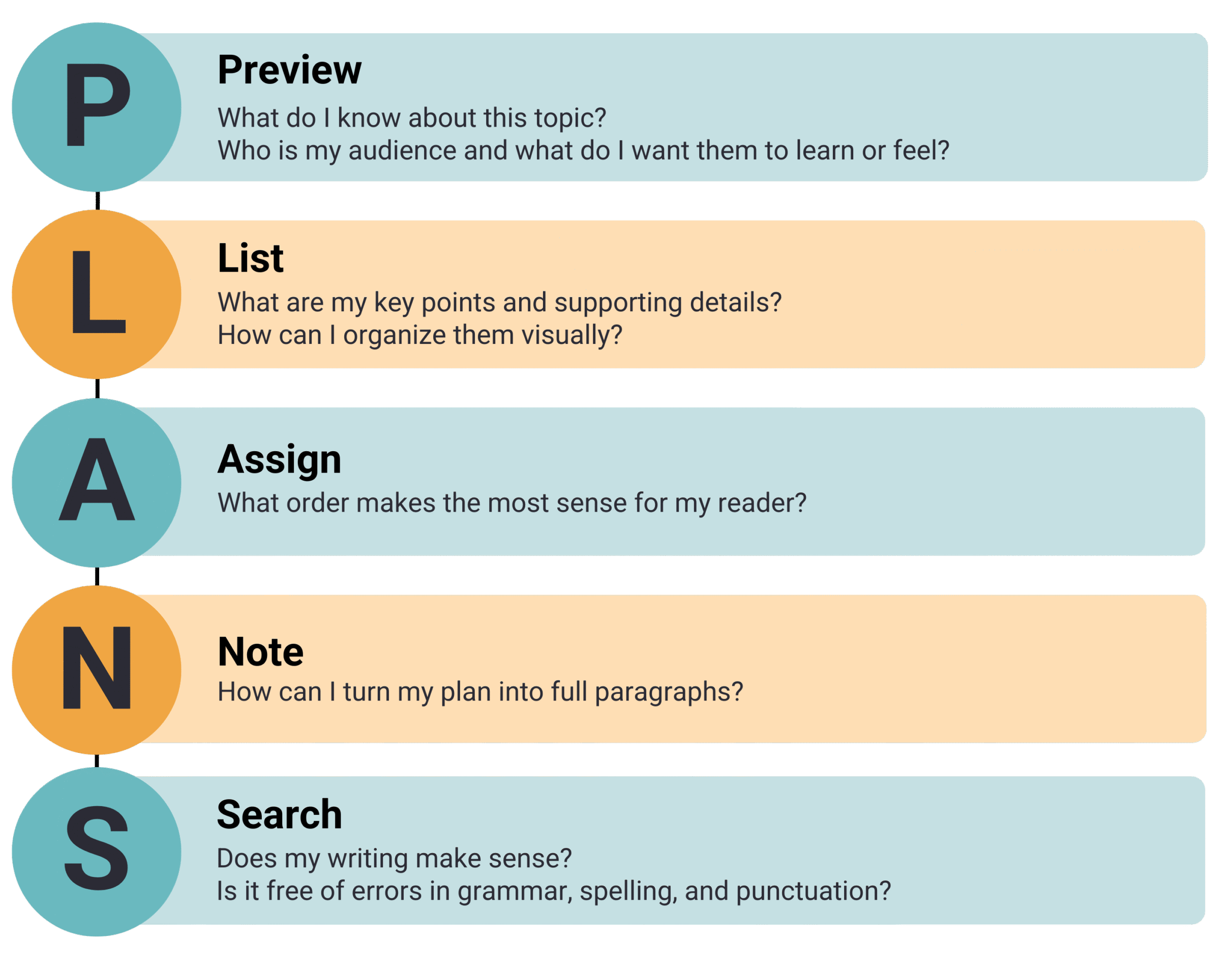
The PLANS (Preview, List, Assign, Note, Search) strategy provides students with a structured, step-by-step approach to organizing and developing their writing from start to finish. It breaks the writing process into manageable stages, guiding students from generating ideas to organizing them logically, expanding them into full sentences, and revising for clarity and correctness. By following this sequence, students learn to think more intentionally about their audience, purpose, and organization, rather than jumping straight into drafting. Over time, consistent use of PLANS helps students build confidence, reduce overwhelm, and develop stronger, more coherent writing habits.
Learn More
Troubleshooting
- Students struggle to generate ideas
→ Use class brainstorming or provide sources for research
→ Prompt: “What do you already know about this topic?” - Writing lacks detail
→ Prompt students to expand and elaborate
→ Prompt: “Can you tell me more about this idea?” - Students feel overwhelmed by planning
→ Chunk the steps over multiple days
→ Prompt: “Today we’re only focusing on listing ideas.” - Students skip revision (Search step)
→ Turn editing into a peer activity
→ Prompt: “Let’s read your writing out loud together.” - Students struggle to organize ideas logically
→ Guide them through sequencing
→ Prompt: “What should your reader learn first?”
Adaptations
- Provide sentence starters and paragraph frames
- Use the PLANS Frame graphic organizer with visuals
- Allow speech-to-text for idea generation
- Offer teacher conferencing during each step
- Use peer collaboration for brainstorming (Preview, List, Assign)
- Provide partially completed graphic organizers
- Chunk steps across multiple lessons
- Include checklists with icons for each step
- Allow oral discussion before writing
Key Takeaways
- PLANS builds strong organization by guiding students step-by-step
- The strategy promotes metacognition and intentional thinking
- Breaking writing into stages reduces overwhelm and writer’s block
- Students gain confidence with a repeatable writing process
- Revision becomes more purposeful through the Search step
- The strategy supports independence while allowing for scaffolding
Case Study Example
She notices that many students jump into writing without a clear plan, resulting in disorganized and incomplete work. To address this, she implements PLANS as a structured process to guide students from brainstorming to revision.
Ms. Carter introduces each step of PLANS using a think-aloud and a visual graphic organizer.
She models:
Preview: Identifying topic, audience, and purpose
List: Brainstorming key ideas and details
Assign: Numbering ideas in logical order
Note: Expanding ideas into full sentences and paragraphs
Search: Reviewing writing for clarity and errors
Students:
Work in small groups to brainstorm ideas
Use a graphic organizer to plan their writing
Write independently during the Note step
Participate in peer review for the Search step
Jordan, a student who often writes disorganized responses, initially writes:
“Camels live in the desert. They have humps. They can survive a long time.”
Using PLANS:
Preview: Identifies the goal of explaining how camels survive
List: Brainstorms ideas (humps, water storage, environment)
Assign: Orders ideas logically
Note: Expands each idea into full sentences
Search: Edits for clarity and flow
Revised version:
“Camels are well adapted to survive in the desert. One way they do this is by storing fat in their humps, which provides energy when food is scarce. In addition, camels can go long periods without water by conserving moisture in their bodies. These adaptations help camels live in harsh desert environments.”
Ideas are sequenced logically with clearer flow.
Students include more detailed explanations and support.
Writing improves in clarity after revision.
Students feel more confident because they have a clear process to follow.
Over time, students begin applying PLANS independently.
Downloads